
Beyond Fitness: Cortisol, Neuroplasticity and Brain Performance
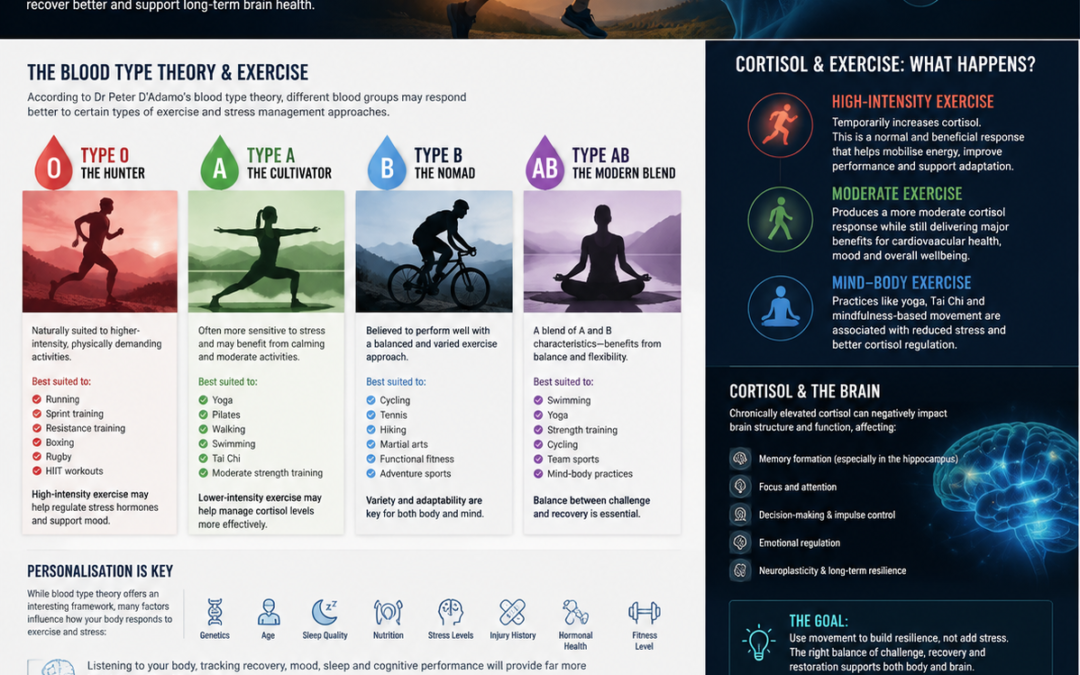
While blood type theories focus primarily on diet and exercise preferences, modern neuroscience offers a fascinating insight into how exercise influences the brain itself.
One of the most significant factors is cortisol.
In healthy amounts, cortisol is essential for performance. It sharpens focus, mobilises energy and prepares the body to respond to challenges. Problems occur when stress becomes chronic and cortisol remains elevated for extended periods.
Over time, excessive cortisol exposure can affect several key areas of the brain responsible for cognitive performance.
Memory and Learning
The hippocampus plays a critical role in memory formation and learning. Research has shown that prolonged exposure to elevated cortisol may impair the ability to form new memories and retrieve existing information effectively.
Many people experiencing chronic stress report symptoms such as:
Forgetfulness
Difficulty concentrating
Reduced mental clarity
Brain fog
These symptoms are not simply psychological. They reflect genuine physiological changes occurring within the brain’s stress-response systems.
Executive Function and Decision-Making
The prefrontal cortex acts as the brain’s chief executive officer.
It governs:
Decision-making
Planning
Emotional regulation
Impulse control
Strategic thinking
Chronically elevated cortisol can impair these functions, making it more difficult to think clearly under pressure, solve complex problems or regulate emotions effectively.
For athletes, business leaders, military personnel and emergency responders, maintaining optimal executive function is often the difference between success and failure.
Neuroplasticity: The Brain’s Ability to Adapt
One of the most exciting discoveries in neuroscience is neuroplasticity.
Neuroplasticity refers to the brain’s ability to reorganise, adapt and form new neural pathways throughout life.
Exercise is one of the most powerful stimulators of neuroplasticity.
Regular physical activity has been shown to:
Promote the growth of new neural connections
Support learning and memory
Improve mood and emotional resilience
Enhance cognitive performance
Protect against age-related decline
This is where exercise becomes far more than a tool for physical fitness. It becomes a mechanism for strengthening the brain itself.
Reaction Time and Cognitive Resilience
At CTE Wellbeing, we are particularly interested in the relationship between movement and cognitive performance.
Reaction time is often viewed purely as a sporting skill. In reality, it reflects the efficiency of communication between the brain and body.
When stress levels remain elevated for prolonged periods, reaction times can slow, decision-making becomes less efficient and cognitive fatigue develops.
By contrast, appropriately structured exercise combined with adequate recovery can help:
Improve processing speed
Enhance focus
Increase reaction time performance
Support emotional regulation
Build cognitive resilience
The goal is not simply to train harder.
The goal is to train smarter.
PTSD Recovery and Stress Regulation
For individuals recovering from trauma, including military veterans, emergency service personnel and others exposed to prolonged stress, understanding cortisol becomes especially important.
Traumatic experiences can disrupt normal stress-response systems, leading to persistent activation of the body’s fight-or-flight mechanisms.
Appropriately prescribed exercise can help support recovery by:
Reducing baseline stress levels
Improving sleep quality
Enhancing mood
Supporting healthy neuroplasticity
Promoting emotional regulation
While exercise is not a replacement for professional treatment, it can form an important component of a comprehensive recovery strategy.
The CTE Wellbeing Approach
At CTE Wellbeing, we view exercise as more than physical training.
Every movement, every challenge and every recovery period provides an opportunity to strengthen the brain.
Whether your goal is improved sporting performance, workplace productivity, injury recovery or enhanced wellbeing, the objective remains the same:
To create a brain that is adaptable, resilient and capable of performing under pressure.
Blood type theories may provide an interesting framework for understanding personal preferences, but the real story lies in how exercise influences neuroplasticity, cognitive performance and long-term brain health.
When exercise is combined with effective recovery, quality sleep, balanced nutrition and stress management, it becomes one of the most powerful tools available for optimising both body and mind.
Final Thought
Your greatest asset is not your muscles.
It is your brain.
Train it wisely, challenge it consistently and allow it the recovery it needs to adapt.
The result is not simply improved fitness, but enhanced focus, sharper decision-making, faster reactions and greater resilience in every aspect of life.